The Voices of War
‘The Voices Of War’ is guided by a simple vision—to scratch below the simple narratives of war.
Listen on:





‘The Voices Of War’ is guided by a simple vision—to scratch below the simple narratives of war through the voices of those who understand its complexities.
To do this, I speak with refugees, soldiers, negotiators, academics, development workers, and anyone else whose life has been shaped by war, be they a survivor, a perpetrator, a mediator, a student, or a healer of it.
Ultimately, I want to make it lucid that neither war nor peace is a forgone conclusion. Both are a product of upstream causes that make one or the other more likely. Understanding and embracing this fact is critical when trying to find moral and ethical solutions to our many local, regional, and global challenges.
Episodes
Monday Jun 20, 2022
Monday Jun 20, 2022
Today is June 20th, and it is World Refugee Day. It has prompted me to reflect on my most recent episode, where I recorded an update on the situation in Ukraine with guests Arne and Mike. I’m heartened to see the interest the conversation has received—not for bragging rights, but because it helps, ever so slightly, to keep the attention on those who must live with the consequences of this invasion, including the more than 7 million individuals who have already been forced to flee, and whose real battle has only just begun.
An unfortunate reality of our current times is that conflicts around the world are forgotten almost as quickly as they begin. Since the world took notice of the Russian invasion of Ukraine almost four months ago, outrage and interest has subsided such that any updates on the war feature less and less frequently on most major news sites. But we shouldn’t be surprised. We only need to look at other ongoing conflicts—take Yemen, Afghanistan, Syria, Ethiopia, or Sudan, for example, where hundreds if not thousands of lives have been lost just this year alone—to see how quickly conflicts disappear from our collective consciousness.
Aside from the difficulties faced by the estimated one hundred million refugees fleeing various conflict zones across the globe, one of the aspects that affects and saddens me the most is the recognition that for these people, it is only after they are long forgotten by the rest of us that their true battle begins.
These conflicts are so deeply personal to me because, as most of you by now know, I am a product of the Bosnian war from the early 90’s. When the war broke out in my home city of Sarajevo, I was 10 years old. Before the war, we lived a completely regular, or even a privileged life. My mum worked as a physics professor at one of the country’s best high schools and my dad was an engineer working at one of the biggest and most-prominent engineering companies in former Yugoslavia. This was the same company that brought Russian gas into the Balkans, as well as the company that engineered Saddam Hussein’s personal bunker in Baghdad. In short, my brother, who is three years older than me, and I, weren’t left wanting for much. Apart from school, our weekdays included lots of playing and running around the neighbourhood with the dozens of other children living on our street. Weekends always included visits to my paternal grandmother, who lived in the centre of Sarajevo, as well as my cousins, both from mum’s and dad’s side. We’d escape Sarajevo to our weekend home my parents were building not far outside of the city, or to the one that my maternal grandfather built all by himself a few hours’ drive out of the city. Winter holidays were spent skiing on one of the nearby Olympic mountains dominating the Sarajevan horizon. In summer, we travelled to a beautiful coastal town in Croatia, where we kept a fully equipped trailer a stone’s throw from a secluded pebbled beach. Life was good.
As I now watch events unfold in Ukraine, I am reminded of the naivety and innocence of not only my parents, but also the rest of the country, that war could simply not occur. I mean, Bosnia is in the heart of Europe. Four hours drive and you’re in Austria, seven and you’re in Germany. No way would the rest of the world let the Bosnian Serbs, supported intimately by Serbia, start a war. The world had moved on, Europe had moved on, from large scale military confrontations. I remember in those final days before all hell broke loose, ordinary citizens, including my parents, neighbours, teachers and just about everyone else, going to huge anti-war protests. I was glued to the TV watching as they sang ‘Give Peace A Chance’, with every Sarajevan who had a lighter, which was just about every one of them, holding it lit above their head and swaying their arms in synch with the song. Although a powerful sight, and one that I get emotional over, even today, I now realise how foolish and naïve it was to hope that Bosnians could stop the inevitable march to war. Those in power had already decided, plans had been drawn up, troops gathered, weapons and supply lines prepared. All that was necessary was a spark to kick it all off.
As I sit here and watch the millions of refugees pouring out of Ukraine, I remember the sense of helplessness of not being able to change your destiny. The night before our suburb was occupied by Serb forces, my mum had a terrible feeling that something was about to happen. It was the first night in 20 years of living in the same house that she could hear the flow of a river, a kilometre away. It was an eerily quiet night. So, the next morning, the four of us, my dad, mum, brother and I, packed a backpack each and left our house to go and stay with my aunt, uncle and two cousins a little further into town. That day, the barricades around Sarajevo went up, and my suburb fell into Serb hands, with many of our neighbours who were left behind experiencing grave abuse by the invading forces. Fighting-age men were detained and taken away as prisoners. Some were never heard of again. Our house, the home I grew up in, was taken over by a police commander who threw my brother’s and my toys out into the backyard to rot. Our neighbour, the angel of a lady who also spent hours teaching me how to read and write, managed to wrestle some of our most-treasured possessions from the intruder, including some our family photo albums. Years later, during her first visit since the war, my mum was able to recover those cherished mementos of a life long gone.
We stayed with my aunt and uncle for those first few days of hell breaking loose. I remember watching tanks occupy positions on top of a small hill about 500m opposite of my aunt and uncle’s house. They weren’t shooting yet, but their command of the entire suburb from an elevated position was daunting as it was perplexing. How is this possible? These were our people? Not even two years ago we all sang the same anthem as Yugoslavia qualified for the semi-final in the FIFA World Cup in Italy. We all speak the same language. Hell, most of us didn’t even know that there was such a thing as different ethnicities. And yet here we were, cowering in the shadow of their barrels awaiting the inevitable. And it didn’t take long. Several times in those first days, air raid sirens echoed around the city, forcing us into bomb shelters scattered around the suburb. We were lucky that my aunt and uncle’s house was literally meters away from one of these, where we spent a number of anxious hours waiting for the threat to lift. A few days later, as the bombing really started, my parents decided that we’d be safer at my grandma’s house, whose apartment was in the heart of the city. We would spend the following few months there, until our escape from Sarajevo.
I remember sitting in the cellar for hours on end, waiting for the shelling to stop. My grandma’s building had about 10 apartments, and just about all of the occupants would hide below ground when the shelling would start. By now, it was occurring frequently enough that the cellars had to be cleaned up, chairs and tables were brought in, as well as candles, food and water. Power would frequently go out, as would water and getting basic supplies was becoming a serious challenge. To pass the time, I remember how my brother and I used a picture of Slobodan Milosevic, the President of Serbia at the time, that had a bull’s eye superimposed on it, for target practice. We had a couple of straws and bits of rolled up paper that we would dip in some water, pretending it was poison. We’d then shoot our weapons at Milosevic’s face, who was smugly smirking at our abysmal efforts from his place of prominence on one of the cellar walls.
Ultimately, I was lucky to have had to live in a besieged Sarajevo for only a few short months. I had recently had a serious ear surgery due to a tumour behind the eardrum of my right ear. My parents knew that I would imminently need another surgery to replace my eardrum which had 13 raptures in it, but they kept this from me at the time as they wanted me to focus on my recovery before worrying about the next time I’d be going into hospital. However, the fragile state of my eardrum, and the now near-constant shelling of the city were a bad combination. At one point, my mum told me to keep my mouth open while the bombs are falling as this would allow me to easier equalise the pressure on my eardrum from any artillery and mortar blasts. I can still hear my brother making fun of me for sitting in the cellar with my mouth permanently open out of fear of my eardrum bursting.
The moment mum and dad broke the news to my brother and I that the three of us would be leaving Sarajevo the next day on a UN convoy, I remember an insatiable rage coming over me. I did not want to leave. I did not want to leave my dad behind; I did not want to leave the rest of our family behind, all my friends. I did not want to leave my city, especially not now when its mere survival was in question. My ten-year old brain could not comprehend what was happening. Only weeks ago, we lived a normal life. I was going to school. We had picnics on the weekend. We were talking about our next holiday on the Croatian coast. It all vanished overnight.
As the next day dawned, one of our neighbours, Raza, sister of one of the nation’s most prominent poets Kiko Sarajlic, gave me a hand-made Pinocchio figurine she once picked up in Italy. It was aimed to give me something to play with, she said, and that we’ll play together upon our inevitable, and surely imminent, return to Sarajevo. The irony of her words, while handing me a Pinocchio figurine, was lost on me until much later.
Looking back, my reflection upon these memories has always had a certain nonchalance; a certain detachment from the reality of what they truly represented of my childhood. Now, as a father, the thought of any child, or in fact any person, having to flee their home after being innocently caught in conflict, much less conflict at the hands of an egomaniacal dictator attempting to assert regional, if not global, dominance, brings tears to my eyes.
Years later, my heart hurts for the fear my parents must have felt. The fear of not knowing what the next day would bring. The fear of not knowing how or if they could keep their young children alive and safe. The fear of the future that would befall their children should they be left without a parent or guardian to look out for them. The fear of the trauma and scars that may imprint on them in the days, weeks, months, and years of hardship to come.
As a father, the thought of my children having to live through such events sends a heaviness through me. But that heaviness is quickly replaced by anger. Because so many of these conflicts are unnecessary. Avoidable, even. And yet we enter into them so lightly. Far too lightly.
Thinking back to my own experiences, I know that what I lived through was easier than what my parents lived through. Childhood resilience is a wonderful thing. But, having to help your wife and children flee while you stay back to defend your homeland, as was the case for my father, or having to seek refuge in a foreign country where you don’t speak the language or have any of your qualifications recognised, as was the case for my mother, seem like far more challenging experiences. Watching your children become marginalised as they’re branded the poor foreigners in a new school. Having to rely on government handouts for the food, clothing and shelter you once provided in abundance for your family. Lining up for hours on end at an Immigration Office to apply for the less-than-welcoming residence status known as ‘Duldung’, which roughly translates to ‘tolerating or bearing you’. Many mistook this for a residence permit. It wasn’t! It was merely the suspension of the state’s obligation to deport you. It was a tactical pause, in your otherwise precarious existence and statelessness. After all that, there are the next 30 years coming to terms with never knowing the final resting place of friends and family, or the trauma associated with seeing your loved ones killed in front of your eyes. There is the loss of your identity, your history, your memories, yourself. These are the unspoken, unseen, unaccounted costs of war.
As the discussion around the invasion of Ukraine moves onto what a decisive victory looks like and how an end may come about, I urge those that care, those who are angered by needless acts of violence, to remember that for millions of innocent survivors, both in Ukraine and Russia and around the world, often, the immediate costs of these conflicts are the lightest and most superficial. The real costs—those which our children, families, and our communities bear, will play out in the months, years, and decades to come. I only need look to my own experience, where almost 30 years on, the balcony and building from which I watched those tanks roll in, still carry the scars from rockets and artillery of my childhood, to know that these are costs that humanity we’ll be paying for generations to come.
On this Refugee Day, take a moment to pause and look around. Take stock of what you have, and not of what you’re missing. Take comfort in the relative safety of your country, of a roof over your head, your job, or the car you might be driving right now. Think about the family dinner you get to enjoy tonight, or your child’s birthday party you get to organise. Think about the bar you’ll go to for ‘knock-off drinks’. Think about all of that, and then remember the 100 million refugees who won’t be thinking those thoughts.
And for those of you in positions of authority, or those who might command troops in war, take a moment to think about the next order you’ll give. Think about the impact that bomb, rocket, shell, or round will have. Not just on your target, but on those you might write off as collateral damage. Remember that the few minutes it took you to give, or to carry out an order, might leave physical, psychological, and spiritual scars on a child lasting a lifetime. What might be your acceptable collateral damage, might be someone’s mother, father, sister, or brother. It might be someone’s husband, wife, boyfriend, or girlfriend. It might be someone’s friend. And one of those your bombs force to flee, might be a child facing a life of uncertainty and instability. A child, just like me.
Finally, and where I hope this thought bubble to land, think about what you can do to help. Can you forgo a few coffees or drinks, and donate the money to the UNHCR, or another of the many amazing organisations helping those most in need? Can you donate your time to help in a shelter? What about old clothing? Can you donate some of it? How about attending one of the many activities marking the day? If nothing else, use your voice on social media or elsewhere to increase awareness of this growing need. But whatever you do, don’t just turn away.
Music: Adagio For Strings, by Samuel Barber
Tuesday Jun 14, 2022
Tuesday Jun 14, 2022
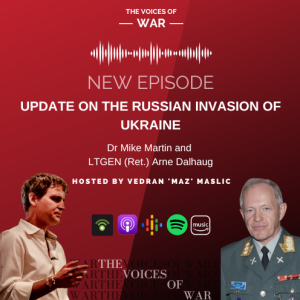
Today, I spoke with Dr Mike Martin and retired LTGEN Arne Dalhaug, who have both provided regular commentary on the Russian invasion of Ukraine in regular and social media.
Mike is a former British Army Officer who subsequently completed his PhD studying war and conflict. He has published a number of books, including ‘An Intimate War’, still one of the go-to books on understanding Afghanistan, as well as ‘Why We Fight’, a book that explores root causes of human conflict and war.
Arne is a retired three-star general who was previously the Deputy Chief of Norwegian Armed Forces, served as the Norwegian Military Representative to the NATO Military Committee, and was the Commandant of the NATO Defense College. After retiring from the military, Arne served in a senior position for the OSCE in the non-government-controlled area in eastern Donbas in Ukraine.
They join me today for an update on the ongoing Russian invasion of Ukraine. Some of the topics we covered are:
Current operational situation on the ground
The potential deception of Sieverodonetsk
State of the Russian Army
The likelihood and ‘dangers’ of a peace deal
The risk of nuclear war
Ukrainian requirements to sustain combat operations
The role of Turkey
Chinese view of the war
Putin’s most-likely and most-dangerous courses of action
For previous discussions with Mike and Arne, check out these episodes:
Arne:
Arne Dalhaug and Wolfgang Sporrer - On the War in Ukraine
Special Release: Lieutenant General (Ret.) Arne Bård Dalhaug: On the current Russia/Ukraine crisis
Mike:
Dr Mike Martin - Update on unfolding situation in Afghanistan
Dr Mike Martin & Dr Christopher Ankersen - Afghanistan Update and Future
Dr Mike Martin - a Soldier-Philosopher
-----
If you like what you’ve heard, please consider liking and reviewing the show wherever you get your pods. You can also support the show on our Patreon and Buy Me A Coffee page on the links below:
Patreon: https://www.patreon.com/thevoicesofwar
Buy Me A Coffee: https://www.buymeacoffee.com/thevoicesofwar

Monday May 30, 2022
Monday May 30, 2022
Today, I spoke with John Gartner, whose career as a professional soldier and security adviser spans more than five decades. During that time, he served in the Australian SAS, Rhodesian SAS, Selous Scouts, South African National Intelligence Service and as a trainer for Sri Lankan Infantry and Special Forces units. He also provided security and close protection advice to a former Saudi Arabian oil minister as well as for the Brunei Royal Family.
John joins me today to discuss lessons learnt throughout his career, which is also captured in incredible detail in his memoir titled ‘The Fading Light’. I recently finished this book, which is a combination of unbelievable operational detail as well as reflections of a man who’s seen the best and the worst side of war.
Some of the topics we covered are:
John’s entry into the Australian SAS
Reasons behind joining the Rhodesian SAS
The (changed) profile of a Special Forces soldier
Life and operations in Rhodesia
Reflections on taking a life
John’s perspective on PTSD
The importance of ‘purpose’
War, atrocities, and ‘bad apples’
Selective Western military engagements
Living and working for a Saudi sheik and Brunei Royal Family
The power of cultural and linguistic immersion
The impact of John’s career on his family
Throughout the episode, I referred to several discussions with previous guests. You can find those here:
Jason Pack - On the ’Global Enduring Disorder’
Marc Garlasco - War through the eyes of a Pentagon Chief of High Value Targeting
Harry Moffitt - A Humble Warrior
If you like what you’ve heard, please consider liking and reviewing the show wherever you get your pods. You can also support the show on our Patreon and Buy Me A Coffee page on the links below:
Patreon: https://www.patreon.com/thevoicesofwar
Buy Me A Coffee: https://www.buymeacoffee.com/thevoicesofwar
Monday May 16, 2022
Monday May 16, 2022
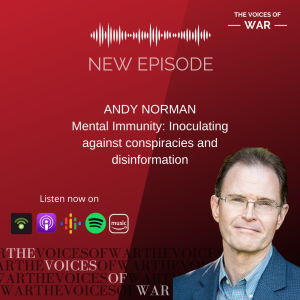
My guest today is Dr Andy Norman, who is the award-winning author of ‘Mental Immunity: Infectious Ideas, Mind-Parasites, and the Search for a Better Way to Think’.
His research illuminates the evolutionary origins of human reasoning, the norms that make dialogue fruitful, and the workings of the mind’s immune system. He champions the emerging science of mental immunity as the antidote to disinformation, propaganda, hate, and division.
Currently, Andy directs the Humanism Initiative at Carnegie Mellon University and is the founder of CIRCE, the Cognitive Immunology Research Collaborative.
Some of the topics we covered include:
Andy’s entry into philosophy
The mind’s ‘immune system’
Definition of ‘mind parasites’
Manipulation gone to scale
Simple conspiracy vs complex reality
The challenge of debating against conspiratorial thinking
The incentives that fuel misinformation
How to prevent mind infections
Determining whether a belief is ‘reasonable’
Evolutionary origins of our capacity to ‘reason’
Dangers of confirmation bias
Factors that make us vulnerable to ‘mind parasites’
The dangers of hitching belief to identity
Developing a ‘mind vaccine’
The ‘New Socratic Method’
During the show, Andy and I discussed a paper he wrote in response to Hugo Mercier and Dan Sperber’s book ‘The Enigma of Reason’. You can download that paper here.
-----
If you like what you hear, please consider liking and reviewing the show wherever you get your pods. You can also support the show on our Patreon and Buy Me A Coffee page on the links below:
Patreon: https://www.patreon.com/thevoicesofwar
Buy Me A Coffee: https://www.buymeacoffee.com/thevoicesofwar
Monday May 02, 2022
Monday May 02, 2022
My guest today is Jason Pack, who is the author of ‘Libya and the Global Enduring Disorder’. Jason is also a Senior Analyst for Emerging Challenges at the NATO Defense College Foundation in Rome where he leads a program titled ‘NATO and the Global Enduring Disorder’, which seeks to produce a range of content analysing our current era of geopolitics while proposing actionable solutions to our most pressing collective action challenges.
Jason is also the President of Libya-Analysis LLC, a boutique consultancy providing strategic advice to any organisations seeking to make sense of the latest political, economic, commercial and security developments in Libya. He is also the founder of the US-based non-profit ‘Eye on ISIS’, which conducts research into Islam and Islamist movements in and outside of Libya.
Some of the many topics we covered are:
Jason’s background and entry into the study of conflict
Behaviouralist, rather than realist, view of International Relations
Meaning of ‘incumbent psychology’
Decline in American exceptionalism
Defining the Global Enduring Disorder
‘Deliberative disorder’ as a political policy
Difference between the war in Iraq and conflicts like Libya, Syria, Yemen, Venezuela or Ukraine
Some of the causes behind the Global Enduring Disorder
The benefits of a global hegemon
Why market economics was not enough to unite the world
Western failures after the Cold War
The importance of social trust to domestic order
Absurdity of Libya and its representation of the Global Enduring Disorder
The complexity of the Global Enduring Disorder
The role of technology and social media in the Global Enduring Disorder
If you like what you’ve heard, please consider liking and reviewing the show wherever you get your pods. You can also support the show on our Patreon and Buy Me A Coffee page on the links below:
Patreon: https://www.patreon.com/thevoicesofwar
Buy Me A Coffee: https://www.buymeacoffee.com/thevoicesofwar
Sunday Apr 17, 2022
Sunday Apr 17, 2022
My guest today is my good friend, Duncan Spinner. Since 2015, Duncan has been working in Ukraine and for four years was the OSCE Head of Operations for Luhansk.
Apart from sharing information on the current situation in Ukraine, this episode is also an appeal for your help in getting at-risk individuals out of harm’s way. As you’ll find out, Duncan and a small team of professionals are informally helping some of the most-vulnerable civilians whose lives are in grave danger. Please consider supporting the below GoFundMe page. Every donation helps save the lives of innocent Ukrainians.
https://www.gofundme.com/f/smm-veterans-for-smm-local-staff
Some of the other topics we covered are:
Snapshot of Duncan’s extensive experience working in conflict affected nations
Work in Ukraine as the OSCE Head of Operations for Luhansk
Questioning the Russian mindset, interpretation of victory and relationship to time
Reflecting on the ‘Russian way of war’
The power of narrative and risk of hubris
Informal rescue of at-risk and vulnerable Ukrainians from danger
The reality of those fleeing Ukraine
Getting personal protective equipment to fighters in Ukraine
The moral imperative of doing something to help
Supporting Duncan and his team
If you like what you’ve heard, please consider liking and reviewing the show wherever you get your pods. You can also support the show on our Patreon and Buy Me A Coffee page on the links below:
Patreon: https://www.patreon.com/thevoicesofwar
Buy Me A Coffee: https://www.buymeacoffee.com/thevoicesofwar
Monday Apr 11, 2022
Monday Apr 11, 2022
Today, I spoke with Dr Deane-Peter Baker, a military ethicist, who is an Associate Professor of International and Political Studies in the School of Humanities and Social Science at UNSW Canberra, where he also is co-Convenor of the UNSW Canberra Future Operations Research Group.
Deane’s work focuses mainly on the ethics of armed conflict. His current area of focus is on ethics and special operations, and he is a regular consultant to Australia’s Special Operations Command as well as the Australian Defence Force more broadly.
He joins me to today to discuss one of his recently published books, Morality and Ethics at War: Bridging the Gaps Between the Soldier and the State. Some of the topics we discussed are:
Deane’s entry into the field of military ethics
Difference between ethics and morality
Idea of individual freedom
Inculcating moral frameworks
Distinction between jus ad bellum and jus in bello
‘Disciplined disobedience’
Understanding ‘ethics inhibitors’ in a military context
Training with ethics in mind
Moral drift and moral injury
The ‘Guardian ethos’
Interests vs values argument
‘Ethical triangulation’
If you like what you’ve heard, please consider taking 30 seconds to like and review the show wherever you get your pods. You can also support the show on our Patreon and Buy Me A Coffee page on the links below:
Patreon: https://www.patreon.com/thevoicesofwar
Buy Me A Coffee: https://www.buymeacoffee.com/thevoicesofwar
Monday Apr 04, 2022
Monday Apr 04, 2022
My guest today is Dr David Whetham who is a Professor of Ethics and the Military Profession in the Defence Studies Department of King’s College London. He is the Director of the King’s Centre for Military Ethics and delivers or coordinates the military ethics component of courses for around two thousand British and international officers a year at the UK’s Joint Services Command and Staff College.
In 2020 David was appointed as an Assistant Inspector-General to the Australian Defence Force to assist in the final stages of the Afghanistan Inquiry and is the author of the report’s final Annex. He joined me to discuss issues of military ethics. Some of the topics we covered include:
David’s journey into military ethics
Defining military ethics
Jus ad bellum vs Jus in bello
Government and military tension when jus ad bellum is not met
Political leaders’ impunity when sending troops to war
Interests vs values debate
Impact of broken justifications for war
Afghanistan and impact of poor mission definition
Narrative vs reality and resulting disillusionment
Impact of the environment and whether atrocities in war are inevitable
Preparing our troops for moral dilemmas
Environmental elements that contribute to ethical demise
Special Forces, but not special
Mitigating circumstances to atrocities
Ethical drift and institutional responsibility
Realistic training for ethical dilemmas
Training to make the right decision, quicker
David mentioned the recent launch of a free app to help military service members make more informed decisions. You can find the app for both Apple and Android by searching for Military Ethics: Cards for Humanity.
Monday Mar 28, 2022
Monday Mar 28, 2022
My guest today is Carl Miller who is the co-founder of the Centre for the Analysis of Social Media at Demos. For the past nine years, he's been building new machine learning-driven approaches to robustly study online life and has written over 20 major studies spanning online electoral interference, radicalisation, digital politics, conspiracy theories, cyber-crime, and internet governance.
His debut book, The Death of the Gods: The New Global Power Grab was published in 2018 and won the 2019 Transmission Prize. He presents programmes for the BBC's flagship technology show, Click and has written for Wired, New Scientist, the Sunday Times, the Telegraph and the Guardian.
He joined me to discuss Information Warfare, cyber-attacks, weaponisation of social media and other challenges, and to do so with a particular focus on the ongoing invasion of Ukraine. Some of the topics we discussed are:
Carl’s entry into this field
Terrorists as conspiracy theorists
Profiling a conspiracy theorist
Understanding data
On the ‘Death of Gods’
The power of open-source intelligence
Emergence of information warfare
Frictionless engagement and the Attention Economy
TikTok and censoring of data
Has Ukraine really won the Information War against Russia?
Suspicious Pro-Russian influence operations in BRICS countries
Background and methodology of the BRICS research
Assessment of pro-Russian campaigns in BRICS countries
Cost of attacking vs defending against information operations
Risk of hubris
You can find out more about Carl and his work here, and you can see his recent research on pro-Russian influence operations in BRICS countries here.
Friday Mar 18, 2022
Friday Mar 18, 2022
Today, I spoke with Dr Peter Warren Singer, who is a Strategist at New America, a Professor of Practice at Arizona State University, and Founder & Managing Partner at Useful Fiction LLC. He is a New York Times Bestselling author with a multitude of accolades to his name.
His non-fiction books include ‘Corporate Warriors: The Rise of the Privatized Military Industry’; ‘Children at War’; ‘Wired for War: The Robotics Revolution and Conflict in the 21st Century’; ‘Cybersecurity and Cyberwar: What Everyone Needs to Know’ and most recently, ‘LikeWar: the Weaponization of Social Media’, which is the book we talked about today.
Peter is also the co-author of a new type of novel, using the format of a technothriller to communicate non-fiction research. ‘Ghost Fleet: A Novel of the Next World War’ was both a top summer read and led to briefings everywhere from the White House to the Pentagon. His latest is ‘Burn-In: A Novel of the Real Robotic Revolution’ and has been described by the creator of Lost and Watchmen as “A visionary new form of storytelling—a rollercoaster ride of science fiction blended with science fact,” and by the head of US Army Cyber Command as “I loved Burn-In so much that I’ve already read it twice.”
Some of the topics we covered are:
How the concept of #LikeWar was born
The individual vs social media
The power of storytelling in communication
The role of social media in the invasion of Ukraine
Social media – shifting the Who, the When, and the Where
Ukrainian application of best practices
Disconnectedness of Russian narrative
Justness of the Ukrainian cause
'Democratisation' of war
The malleability of the ‘truth’
Lessors learnt from Ukraine’s
During the chat, I referred to an article Peter recently published with Politico. You can access it here.
If you like what you’ve heard, please take 30 seconds to like and review the show wherever you get your pods. It will help the show grow.
You can also support the show on our Patreon and Buy Me A Coffee page on the links below:
Patreon: https://www.patreon.com/thevoicesofwar
Buy Me A Coffee: https://www.buymeacoffee.com/thevoicesofwar
Sunday Mar 13, 2022
Sunday Mar 13, 2022
Today, I spoke with Dmytro Gurin, who is a currently serving Member of Parliament in Ukraine. Dmytro is originally from Mariupol, the besieged city in South-eastern Ukraine that is capturing global headlines, where he has spent his childhood and where he went to university. In the past, Dmytro has also spent more than a decade living in Moscow and is very familiar with Russian political and media machinations.
He joins me today, just after midday on Sunday, 13th of March, Eastern European Time, to discuss the evolving Russian invasion of Ukraine. Some of the topics we covered are:
Current situation in Ukraine
Change of Russian tactics to target civilians
General Russian orientation towards Ukraine
The reality faced by Russian troops
Life in the besieged city of Mariupol
Western predicament and possible ways forward
What Ukraine needs from the West
Possible scenarios inside Russia
Difference between Ukrainian and Russian armies
The state of the Ukrainian nation
Sunday Mar 06, 2022
Sunday Mar 06, 2022
My guest today is MAJGEN Mick Ryan, who only days ago officially retired from more than 35 years of service in the Australian Army. During this time, he has deployed on multiple overseas deployments, has commanded troops at platoon, squadron, regiment, task force, and brigade level, and among the many awards for service and excellence he has received, in 2008, Mick was also awarded the Order of Australia for distinguished leadership of the Australian 1st Reconstruction Task Force in Afghanistan.
He is a recognised expert in leadership, institutional strategy, technology, organisational adaptation and change management, institutional reform, as well as personnel development. Mick is also a prolific writer and speaker, with a particular focus on thinking about and preparing for the battlespace of the future.
This is also what his recently published book is all about. It is titled ‘War Transformed: The Future of 21st Century Great Power Competition and Conflict’ and is a deep dive into how four key disruptors, namely geopolitics, demographics, technology, and climate change, will impact great power rivalry. In short, Mick explores how the dynamics of the nascent fourth industrial revolution and its interplay with the ongoing changes in the way we live as well as dramatic shifts in global affairs will transform tomorrow’s wars.
He joined me today to talk about his book and how it relates to the ongoing Russian invasion of Ukraine. Some of the topics we covered are:
Nature vs. Character of war
Russian vs. Ukrainian Information Operations
Why Putin is fundamentally losing, so far
The role of surprise in this invasion
Re-emergence of Europe
Russian military deficiencies
Two principal decisions Ukraine is facing
The importance of time in the current war
Importance of leadership in war
Critical role of logistics
Impact of the Russian invasion on China
Are ‘our’ wars, different to ‘their’ wars?
21st Century as showdown between Democracy vs. Authoritarianism
Lessons learnt from the Russian invasion
You can find out more about MAJGEN Mick Ryan here. I also recommend you follow his Twitter page (@WarintheFuture) for regular updates on the current crisis and beyond. Lastly, you can view and purchase his book 'War Transformed: The Future of 21st Century Great Power Competition and Conflict' here.
Sunday Feb 27, 2022
Sunday Feb 27, 2022
This episode was recorded at 1000h CET on 27 Feb 2022.
---
Today, I spoke with Arne Dalhaug and Wolfgang Sporrer, both of whom I recently interviewed independently about the crisis in Ukraine (links with longer bios below). Arne is a retired three-star Norwegian Army officer, who also served as a senior officer in NATO and, more-recently, as a senior leader at the OSCE in Ukraine. Wolfgang is currently an Adjunct Professor at the Hertie School in Berlin and was recently the head of the Human Dimension Department of the OSCE in Ukraine.
They join me today to discuss the invasion, current crisis and possible future outcomes. Some of the topics we covered are:
Reason behind Putin’s ultimate invasion
Influence and importance of social media
Narrative control in Russia
Zelenskyy and his communication skills
Russian military and its failures to date
Impact of sanctions and financial measures
Energy sector and Nord Stream 2
China’s orientation towards the invasion and Russia
Other strategic tensions influencing the current situation
Putin’s options from here
You can find more-extensive biographies of both guest in our previous discussions below:
Special Release: Lieutenant General (Ret.) Arne Bård Dalhaug: On the current Russia/Ukraine crisis
Special Release: Wolfgang Sporrer - Providing nuance to the crisis in Ukraine
---
If you like what you hear, please consider liking and reviewing the show wherever you get your pods. You can also support the show on our Patreon and Buy Me A Coffee page on the links below:
Patreon: https://www.patreon.com/thevoicesofwar
Buy Me A Coffee: https://www.buymeacoffee.com/thevoicesofwar
Monday Feb 21, 2022
Monday Feb 21, 2022
My guest today is Marc Garlasco, who began his career as the Chief of High Value Targeting at the Pentagon between 1997 and 2003 where he led targeting teams during operations Iraqi Freedom, Desert Fox, and Allied Force. Marc later worked in senior roles at Human Rights Watch, the United Nations, and the Centre for Naval Analyses.
Throughout his time, he has worked in Afghanistan, Gaza, Georgia, Iraq, Israel, Kosovo, Lebanon, Libya, and other conflict zones. He is a co-author of the ICRC report on Explosive Weapons in Populated Areas, and a co-host of the excellent The Civilian Protection Podcast that tells the story of those harmed by war, but whose voices are rarely heard.
Marc is currently the military advisor at PAX, the largest peace organisation in the Netherlands and works to protect civilians against acts of war, to end armed violence and to build inclusive peace. Some of the topics we covered are:
Marc’s journey into targeting
Developing a picture of Iraq
9/11 and (absence of) link to Iraq
Deliberate vs dynamic targeting
The failed targeting of Saddam
Why targeting fails
Incentives vs intelligence
Impact of ‘humane’ war
How a Collateral Damage Estimate (CDE) is conducted
Reconciling the fact that not all lives are worth the same
Use of drones and accuracy of battle damage estimates
Changing policy to reduce civilian harm
Building bridges between NGOs and the military
Impact of our wars on soldiers fighting them
Marc and I discussed The Civilian Protection Podcast, of which he is a co-host. You can access all episodes of this excellent project here.
Marc also mentioned the upcoming release of a US Department of Defence Memorandum, to be signed by the Secretary of Defence, that will direct the development of a comprehensive plan to mitigate and respond to civilian harm. That memo has now been released and is worth reading. You can find it here.
-----
If you like what you hear, please consider liking and reviewing the show wherever you get your pods. You can also support the show on our Patreon and Buy Me A Coffee page on the links below:
Patreon: https://www.patreon.com/thevoicesofwar
Buy Me A Coffee: https://www.buymeacoffee.com/thevoicesofwar
Wednesday Feb 16, 2022
Wednesday Feb 16, 2022
This is a short introduction to what's in store throughout 2022 on The Voices Of War. As you will hear, the show finally has a Patreon and Buy Me A Coffee page. Please take the time check out the links below and support us if you are able to do so. Every little bit helps to grow the show.
Patreon: https://www.patreon.com/thevoicesofwar
Buy Me A Coffee: https://www.buymeacoffee.com/thevoicesofwar
Thank you and I hope you enjoy The Voices Of War throughout 2022.
Maz
Wednesday Feb 02, 2022
Wednesday Feb 02, 2022
My guest today is Wolfgang Sporrer, who is an Adjunct Professor at the Hertie School in Berlin. He used to be the head of the Human Dimension Department of the OSCE Special Monitoring Mission in Kyiv, where he lead the civilian aspects of conflict management and facilitated and promoted dialogue between the opposing sides.
Before that, he was the head of the international oil and gas company OMV's representation in the Caspian region, where he spearheaded regional efforts to promote the Southern Gas Corridor for the EU.
Previously, he served as the Head of the Europa House of the European Commission in Baku/Azerbaijan and as the Head of the Democratisation Department of the OSCE Presence in Albania. He also served as a political adviser in the EU delegation in Moscow and in several functions for the OSCE in Croatia, Bosnia and Herzegovina and Kosovo.
He joined me to discuss the ongoing crisis in Ukraine. Some of the topics we covered are:
Wolfgang’s background in conflict zones
Defining the conflict
Inner Ukrainian tensions
Ukraine/Russia bilateral relations
East/West dimension
Headlines vs. reality
Irrationality of a possible Russian invasion
Interests of President Biden and President Putin
The absence of a united EU position on Russia
A possible way out
Challenges to overcome
Thursday Jan 27, 2022
Thursday Jan 27, 2022
My guest in this Special Release episode is Lieutenant General (Ret.) Arne Dalhaug, who during his extensive and distinguished career served at the highest levels of the Norwegian Armed Forces, the Norwegian Ministry of Defence, as well as NATO. His several final postings in uniform as a three-star general include serving as the Chief of Defence Staff/Deputy Chief of Norwegian Armed Forces, as the Norwegian Military Representative to the NATO Military Committee, and as the Commandant at the NATO Defense College. After retiring from the military, Arne served for three years in a senior management position for the OSCE in the non-government-controlled area in eastern Donbas in Ukraine. Arne now works as an independent expert on NATO, Russia and conflicts in the post-Soviet domain.
During our conversation we covered topics such as:
Origins of the Ukraine/Russia conflict
Reasons behind President Putin’s current actions
NATO and whether its actions have contributed to the crisis
The likelihood of an actual military invasion
Russian political vs military aims
Impact of the media on the current crisis
NATO cohesion and current posture
Assessment of the most-likely way forward
During the conversation, we discussed an excellent article from the Kyiv Independent, which you can read here.
You can find Arne's extended military biography here.
Thursday Dec 23, 2021
Thursday Dec 23, 2021
Today, I spoke with Mark Willacy, the journalist behind the ABC report ‘Killing Field’ as well as the recently published book ‘Rogue Forces: an explosive insiders’ account of Australian SAS war crimes in Afghanistan’. Even though I stated that I will recommence publishing new episodes on the 21st of February 2022, I am releasing this one as a Special Release as I feel that the contemporary relevance of this conversation warrants it. As you will hear, some of the topics Mark and I covered include the intent behind his journalism, his initial exposure to war and conflict in the Middle East, how ‘Killing Field’ and ‘Rogue Forces’ came about, the people who approached him, impact of the environment on our soldiers, impunity of politicians and much more.
On a personal note, this was by far the most difficult interview I have conducted because of the highly volatile and close-to-home subject. All I ask of my audience is that they take heed of my opening remarks before diving into the interview. This is an important topic that we need to talk about and do so respectfully.
Lastly, you can see my recently published article that I mention here.
---
Full show notes:
My guest today is Mark Willacy. Mark has been a journalist for more than 25 years and has reported for the Australian Broadcasting Corporation, Australia’s national broadcaster, from more than 30 countries. Mark is a seven-time Walkley Award winner and in 2020 he was awarded Australia’s highest honour in journalism, the Gold Walkley, for exposing alleged Australian SAS war crimes in Afghanistan. His winning Four Corners report ‘Killing Field’ made headlines around the world and sparked a federal-police war crimes investigation. Mark’s investigations provided evidence for 12 cases named in the Brereton Report, the independent Australian Defence Force inquiry into war crimes in Afghanistan between 2005 and 2016. Earlier in his career, as the ABC’s Middle East correspondent for four years, Mark also reported on the ground from the Israeli-Palestinian conflict and the 2003 war in Iraq. He was also the Japan correspondent in 2011 when the country was hit by its most powerful earthquake in more than a thousand years. Mark has twice been named Queensland Journalist of the Year and in 2019 he won a Logie Award for his Four Corners’ world exclusive on the Thai cave rescue.
Mark has authored several books, including ‘The View From the Valley Of Hell’ a book about his time in the Middle East in the early 2000s, ‘Fukushima’, which is an account of the 2011 earthquake and the twin catastrophes of the subsequent tsunami and nuclear meltdown. And more recently, he published the book ‘Rogue Forces: an explosive insiders’ account of Australian SAS war crimes in Afghanistan’. He joins me today to discuss this last book, how it came about and its impacts.
Some of the topics we covered:
Marks entry into investigative journalism
His time in the Middle East in the early 2000s
Motivation behind extreme violence in the Middle East
Lessons learnt about human nature
First encounters with the Australian SAS in Iraq
How ‘Killing Field’ and ‘Rogue Forces’ came about
Why Mark released the book when he did
The sources of information for Mark’s book
Impact of the environment on our soldiers
Impunity of politicians
Current state of the media
Narratives surrounding Mark’s book
Mark’s response to Heston Russell’s recent public complaint
The way forward
Lastly, you can see my recently published article that I mention here.
Monday Dec 13, 2021
Monday Dec 13, 2021
In this final episode of 2021, I take a few moments to reflect on the origins of the show, the guests I've had the pleasure of interviewing, some emerging themes, what's in store for 2022 and to give a few important thanks to those who have made the show possible.
We will return again on 21st of February 2022. Between now and then, I will be reposting a few of my favourite episodes that didn't get as much attention as I had hoped they would.
I wish you all a safe festive season and a happy New Year!
Much love,
Maz
Tuesday Dec 07, 2021
Tuesday Dec 07, 2021
Today, I spoke with Samuel Moyn, who is the Henry R. Luce Professor of Jurisprudence at Yale Law School and a Professor of History at Yale University. We discussed his latest book, Humane: How the United States Abandoned Peace and Reinvented War, published in September this year. As you will hear, I found this book to be of immense importance and hope that its contents get attention far and wide, most notably amongst those who send us to war.
Some of the topics Sam and I covered are how the idea of humane war entered our collective conscience; the role the war in Vietnam had in a pivot towards humane war; abdication of diplomacy for the ‘cleanliness’ of war; the traps of the Just War doctrine and its selective interpretations; the role of lawyers in making war ‘just’; impact of 9/11 on making war more ‘humane’; future dangers and much more.
---
Full show notes:
My guest today is Samuel Moyn, who is the Henry R. Luce Professor of Jurisprudence at Yale Law School and a Professor of History at Yale University. He has written several books in his fields of European intellectual history and human rights history, including The Last Utopia: Human Rights in History (2010), and edited or coedited a number of others.
His most recent books are Christian Human Rights (2015), based on Mellon Distinguished Lectures at the University of Pennsylvania in fall 2014, and Not Enough: Human Rights in an Unequal World (2018). His newest book, published in September this year, is titled Humane: How the United States Abandoned Peace and Reinvented War, and will be the focus of our conversation today.
Over the years, Samuel has written in venues such as the Boston Review, the Chronicle of Higher Education, Dissent, The Nation, The New Republic, the New York Times, and the Wall Street Journal.
I recently finished his latest book, Humane, and to say that it was a perspective-altering read would be a huge understatement. It is a deeply insightful and undoubtedly controversial book, and I hope it gets the global attention it deserves. For that very reason, I am truly humbled to have hosted Sam on the show. Some of the topics we covered include:
Sam’s introduction into the field of human rights
The genesis of humane war thinking
Outlawing war vs. humane war
Distinction between pacifism and being anti-war
Vietnam and the focus on the conduct of war
How ending conscription helped perpetuate humane war
Trade of diplomacy for humane war
Importance of 9/11 in evolution of humane war
The issue of terrorists and ‘associated forces’
The role of lawyers in making wars ‘just’
Jus in bello and it’s illusions
Ongoing trajectory of ‘safe’ and ‘clean’ war
Potential dangers of ongoing humane war